The Storyteller Series #1 - Alex Mason, Visual Artist
#1. Alex Mason, Visual Artist
Painting the story of who you are
Creative Medium: Paint, Texture & Colour
Alex Mason
FADE IN.
INT. STUDIO - AFTERNOON
Alex is surrounded by a sea of brightly coloured floral paintings on the wall behind her.
ALEX
I went through a period of time where I felt like I needed to fit in… My beige phase.
She shudders.
ALEX
Like, my doona was grey. Can you believe that?
RACHAEL
(horrified)
Eughh!
Alex nods, adjusting her multicoloured headphones with hot pink nails.
It’s hard to imagine Alex Mason not surrounded by the bright, eccentric colours that have become her signature style. Her textured floral artworks basically jump off their canvases and pull you into their technicolour world where purple native banksias rub shoulders with vibrant pink proteas and waratahs, amongst a sea of roses, daisies and hydrangeas. The NSW-based artist’s entire business model is built around vivid colour, joy and fun. You can’t not smile when you look at an Alex Mason piece.
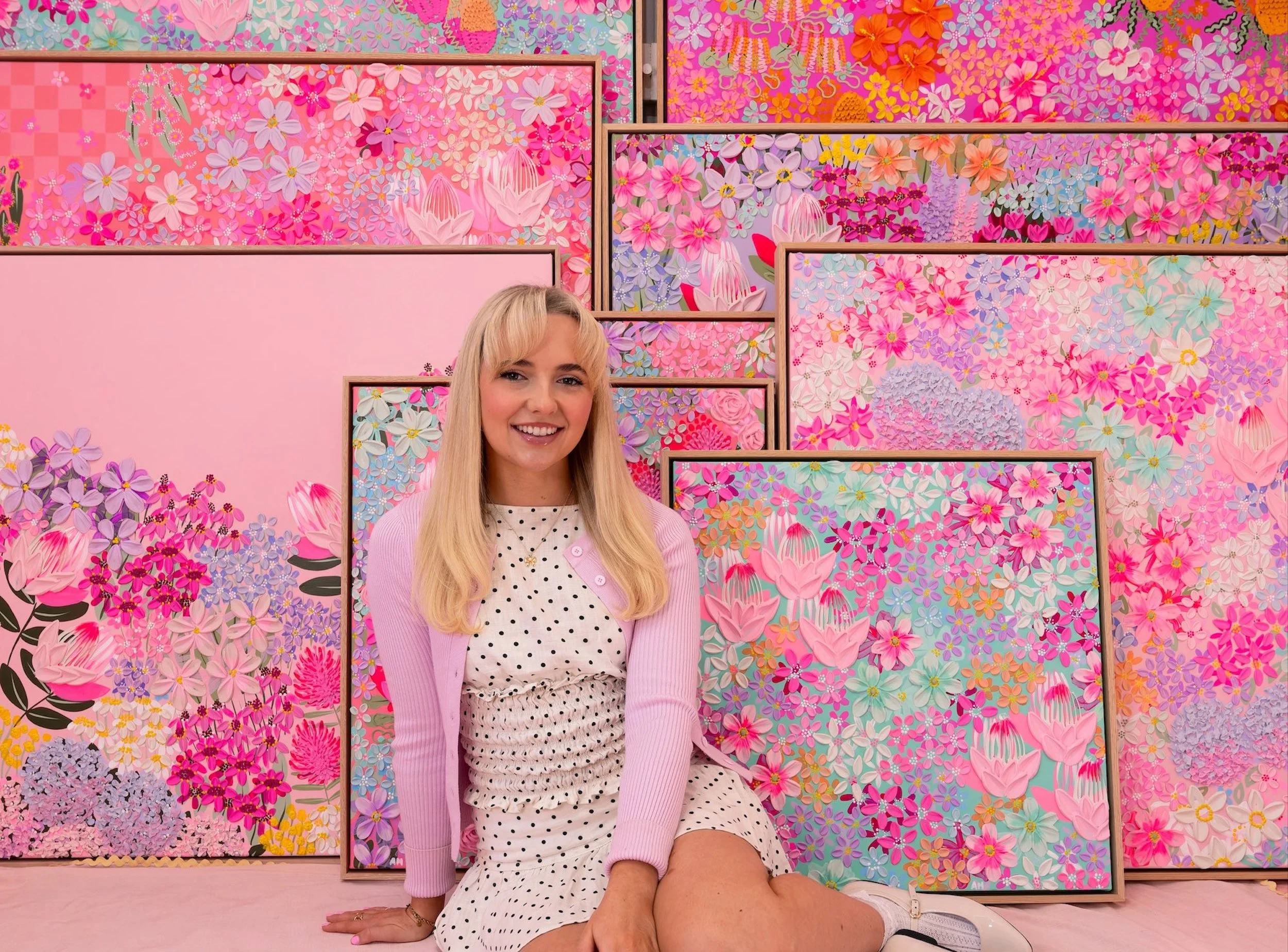
Alex Mason in her studio.
I know this from personal experience. During my pregnancy, the first thing my husband and I bought for our baby girl wasn’t a pram. Not a cot. Not anything practical or pragmatic, no no no. Those things would come later. What I wanted first was to make sure the nursery felt the way I wanted it to feel. Light, joyful, playful. I’d been following Alex’s work for a while and I knew, with every bone in my body, that when I was rocking my future baby to sleep for the three-hundredth time in that room, I didn’t want to be staring at a blank wall. I wanted to be staring at an Alex Mason piece. So our first purchase for bub was made. And I can tell you, my premonition wasn’t wrong. I can’t begin to count the number of times that painting has brought a smile to my face as I’ve stood there swaying, praying, begging for sleep to find its way to my little girl. “It’s just flowers on a canvas at the end of the day”, Alex tells me humbly. But for someone whose mood is affected by their visual surroundings as much as mine is, I know her work is so much more. There’s an authenticity, an obvious un-muted confidence to Alex’s paintings. When I first had the idea for this Storyteller Series, I knew I had to learn more about the human behind the piece of art that’s kept me quietly smiling through this first eleven months of motherhood…
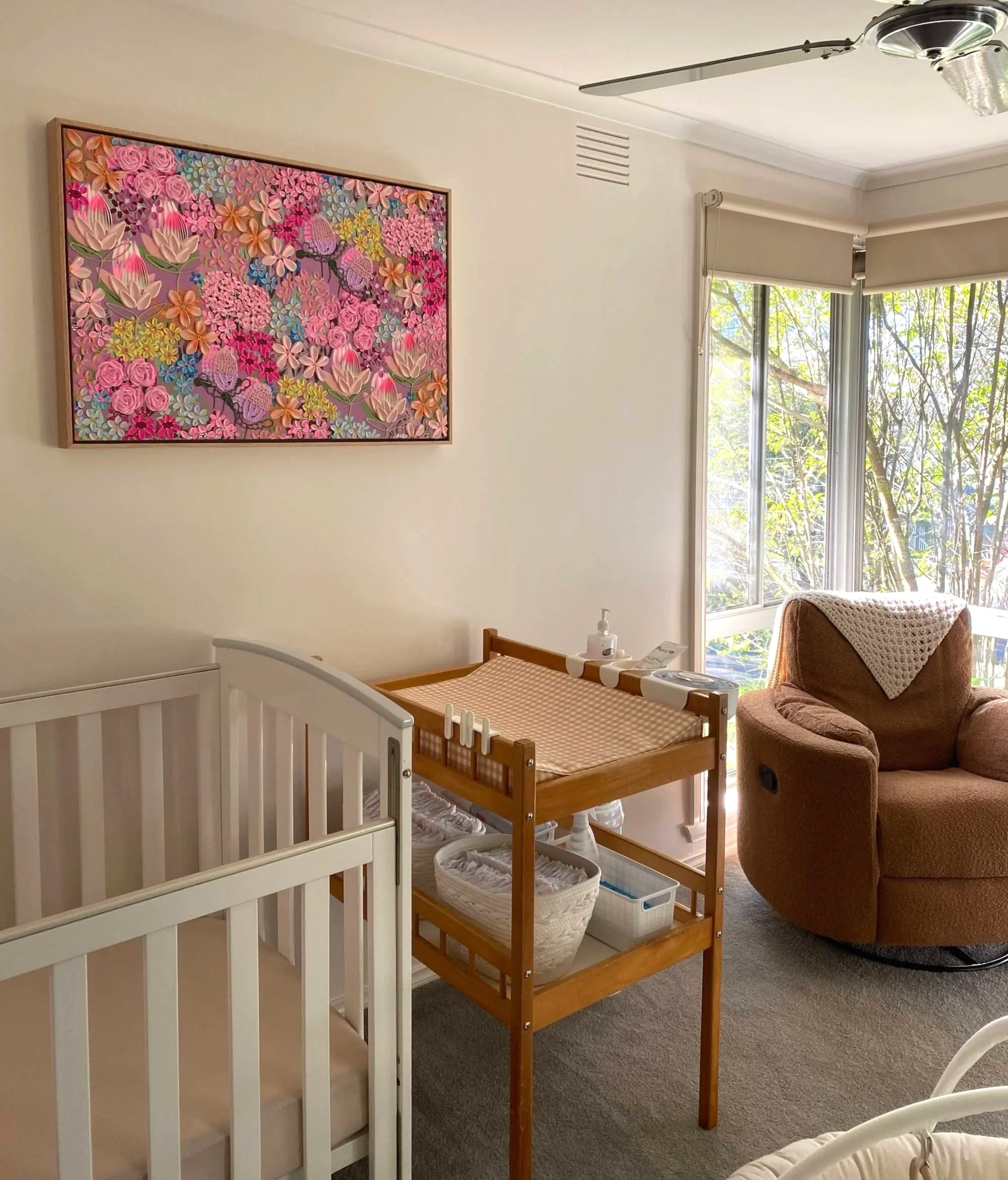
Our Alex Mason painting, ‘Oz Dust’, in our baby’s nursery.
“When you see my artwork, it’s literally the story of me on the canvas”, Alex says. But it wasn’t always the bright, happy story we see now. Her work has very much evolved with her over time. That fitting-in phase she shudders to speak of lasted most of her life. “Even four years ago just before I started my business, I was still in this space of trying to fit in with everything around me. So my first artworks were beige and more neutral because I thought that’s what people expected of me.”
Four years ago, Alex was a youth care worker in residential housing. “A lot of the young people I worked with were in and out of juvie, so their behaviours were unpredictable. They could be scary at times. I was getting a lot of anxiety just going to every shift, not knowing what to expect.” So as a form of stress management in her free time, she returned to something she’d loved doing as a kid – painting. “I was like, painting will calm me down!” Australia was deep in lockdown-days where online courses were in high demand. A friend was running a textured painting course, so she bought it and began experimenting with different materials. “It was like therapy for me. I started using whatever I could find in the kitchen to create petals. Then eventually the petals turned into flowers.” It was the beginnings of what would become the style she’s now known for – mixing acrylic paint with thick acrylic polymer, then applying it to the canvas with piping tools and palette knives. “It’s kind of like icing a cake onto a canvas.” Within six months, she had a new website, a new Instagram account with the daring new title of “artist”, and launched her first four-piece collection. “They sold out straight away and that gave me the confidence to keep pursuing it as a business.” A year later, she’d left her job in social work and like so many creatives only dream of doing, stepped into life as a full-time artist.
I find myself admiring the fact that Alex has been able to make a living from something that’s actually beneficial to her mental health. “What a success story,” I say. “You’re living the dream.” A broad, contented smile floods her face. “I really am.” She’s basically the poster child for that old notion about finding something you love to do and you’ll never “work” a day in your life. “I rarely get anxiety now and I’m excited to get back into my studio each week. Painting is the only time my brain is calm.” The simple act of placing petal after petal relaxes her with its pattern-like, mindful repetition. With a recent ADHD diagnosis, she talks about the hyper-focus sucking her into a time vortex, a deep flow state where hours pass and she hasn’t taken a break. “I blink and I'm like, oh, I need to have some lunch. Then I blink again and I'm like, oh, I need to go home now. It's been hours. But when I’m painting, nothing else around me matters. My studio becomes a mess. It’s collateral damage, really.” Music plays a huge part in her daily process too. Pop albums or musical soundtracks often inspire an artwork, with many of her pieces named after songs. As a radio announcer in a past life, it’s another way of tying her earlier story into her current work. “Part of my ADHD is that I like to listen to the same song or album over and over and I don’t get sick of it. My last two pieces have been Encanto-inspired” (one of her favourite Disney movies). The Wicked soundtrack was another recent inspiration. “I saw Wicked about three times in the cinema. And then we flew to New York to see it. And then our Christmas tree was Glinda themed, everything was Glinda themed and I was just obsessed. I listened to the album all day every day for months. So naturally I had about five artworks named after Wicked.”
Weaving current fashion and design trends through her pieces is another form of Alex’s self-expression. The aqua that’s been so popular during this year’s European summer season has inspired some of her latest background colours. The polka dot vases she painted were a direct reflection of the 1950s trend having a recent resurgence. “I see colour combinations and patterns everywhere that end up in my pieces.”
The beige, neutral tones have well and truly been left behind. Alex’s work has gradually become richer in colour as she’s dropped the “shoulds” and the desire to fit in. “The last few years I've kind of felt myself unmasking and being able to be who I fully am.” That newfound confidence shows in the work. When you look at her pieces, it’s obvious the artist behind them knows exactly who she is. Isn’t afraid of being unique and clearly very much in love with what she’s doing. Not everyone paints native Australian plants in such unexpected colours. Not everyone sees beauty in the weird spikiness of a banksia. Not everyone is brave enough to lean into their love of pink. (“Pink girls get it”, she tells me, and as a fellow life-long pink lover, I really do). Not everyone takes their art off the canvas and paints surfboards, mirrors and vases. Her success has expanded into licensing artwork with local brands onto wetsuits, phone cases, drink bottles and bags. If you walk into your local Australia Post, you might see her brightly-coloured stationery range on pencil cases, notebooks, mouse pads and pens. She’s packaged up and flown her pieces all over the world. She’s starting to mentor other artists to pursue their own goals. A true dream career that seems like it’s only just getting started.
“My dad thinks I’m famous”, she laughs. “Every day he comes out to my studio and he’s like ‘how many Instagram followers do you have now?’ I’m like 80,000 and he’s like ‘What? You only had 70,000 the other day!’ He gets really excited.”
It occurs to me that the reason her business has become so successful is probably thanks to the exact thing she resisted for so long – stepping fully into her uniqueness, not caring what others think. People don’t want to buy art that looks like everyone else’s. People want something different. There’s nothing more appealing than authenticity. That over-used Oscar Wilde quote that I’m going to reference anyway, because no one has ever said it better – “Be yourself; everyone else is already taken.” When we see this in action, we’re emboldened to step into our own individuality. Without realising what she’s doing, Alex owning her own pink-flowery-glittery-musical-pop-culture-loving self is giving others permission to acknowledge their own unique passions and traits. For me, that painting hanging in our nursery signifies so much more than just pretty flowers on a canvas. It’s an example to my little girl that truly owning who you are is cool. It has impact. She might not grow up and love pop music and the colour pink (God help me), but she will know the importance of finding and stepping into the most authentic version of herself.
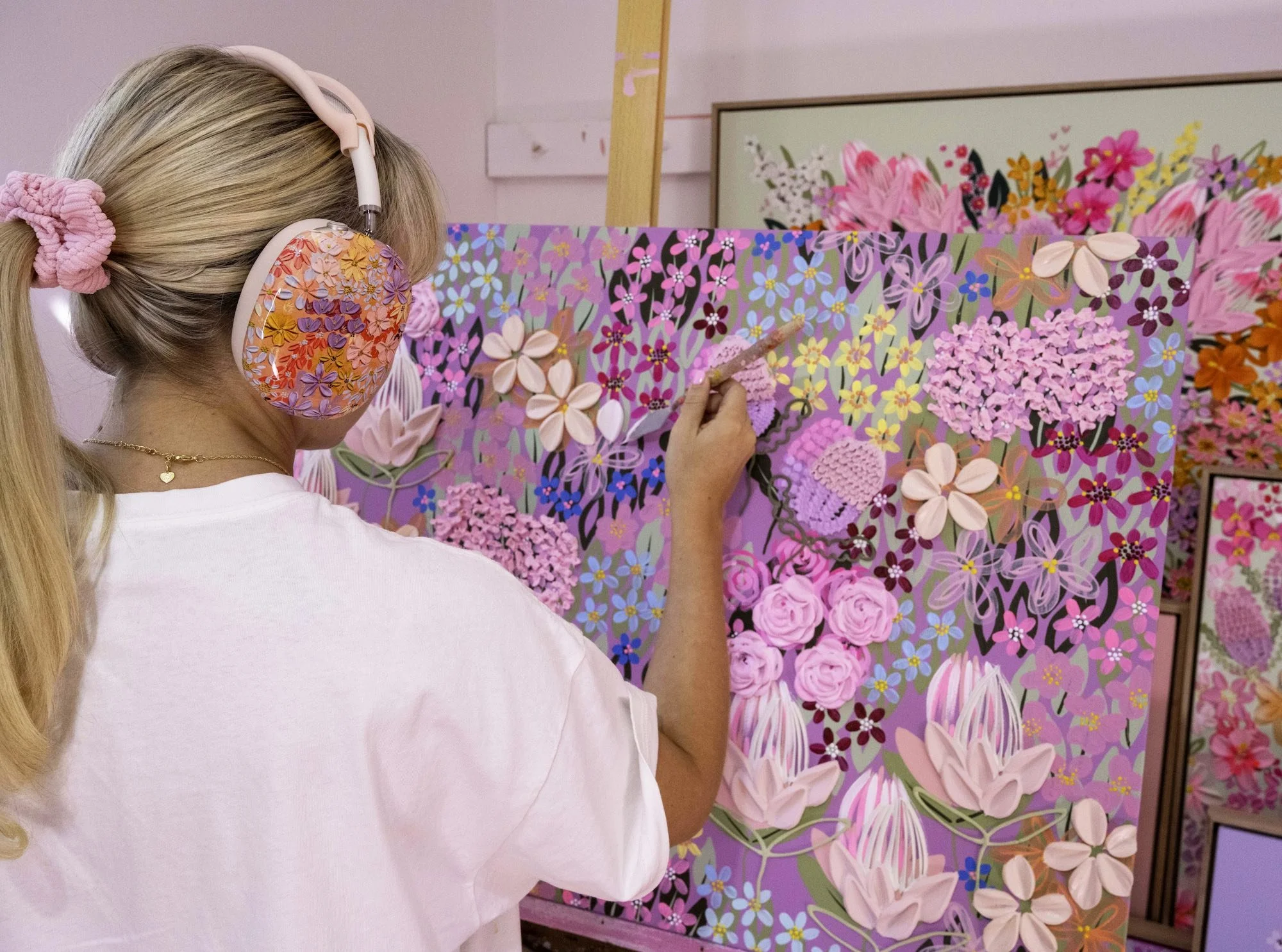
Alex Mason at work.
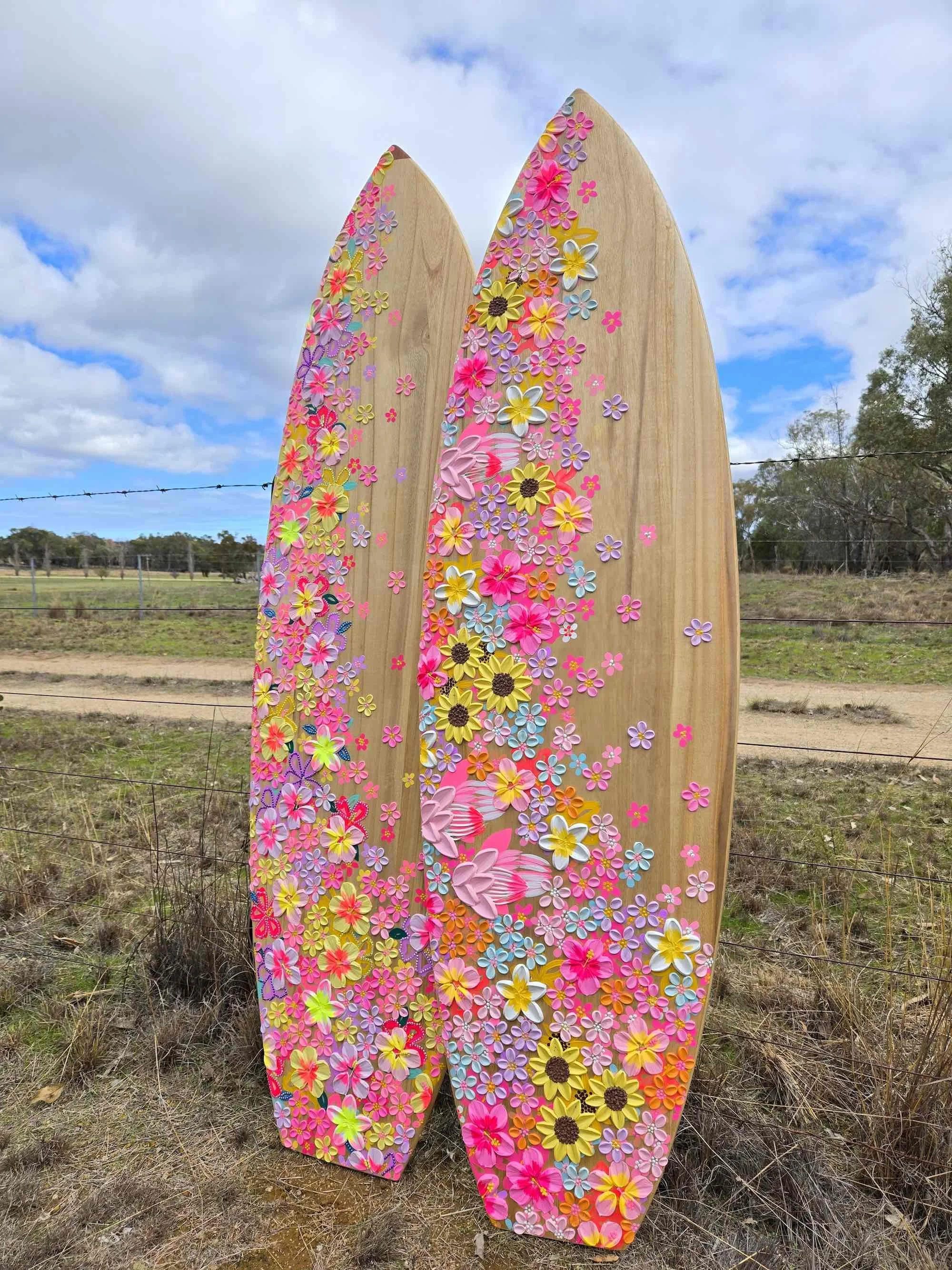
Alex’s bespoke painted surfboards.
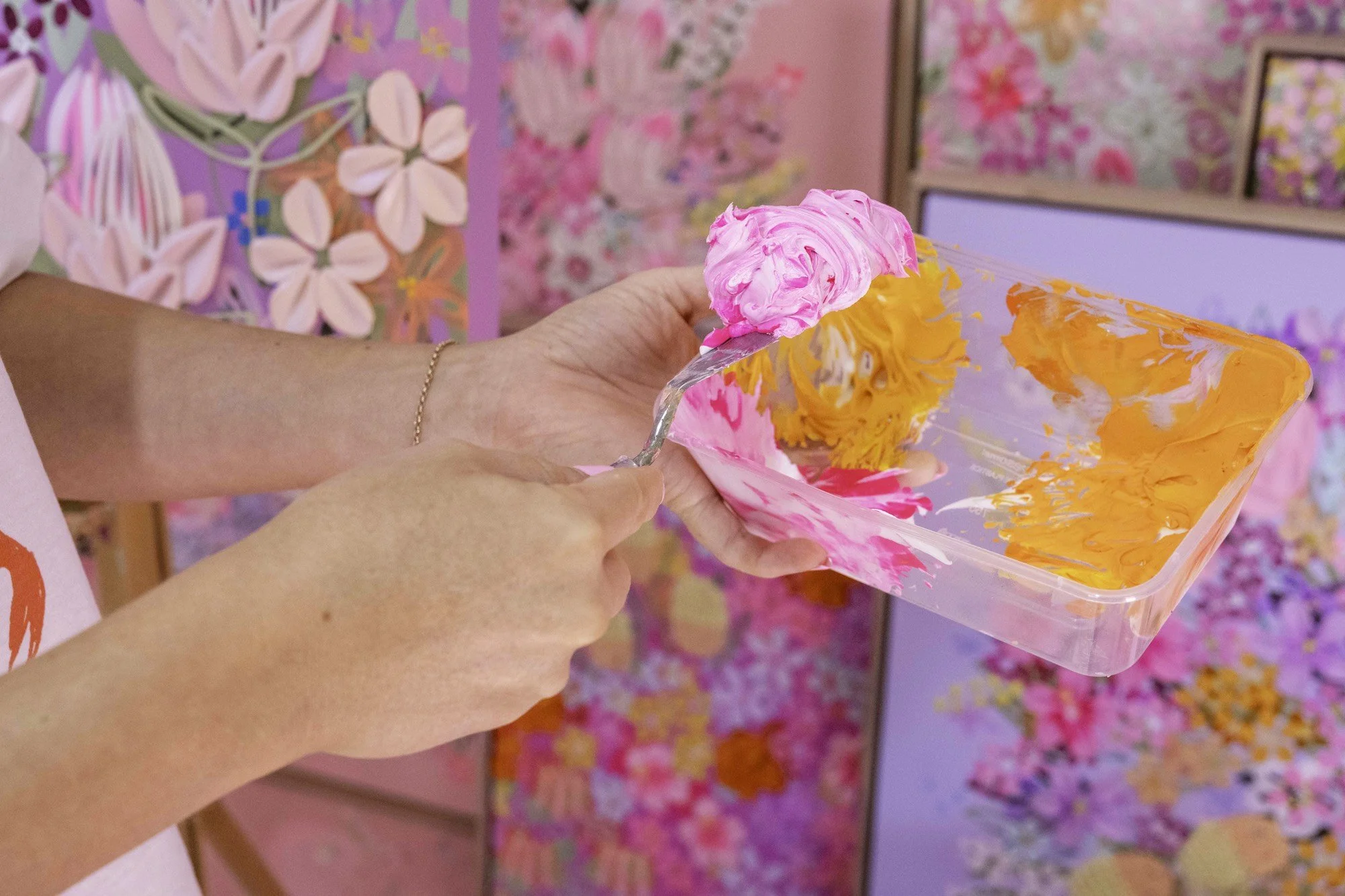
Alex using acrylic paint and polymer to create her textured artworks.
“Art has been a huge part of helping me discover who I am,” Alex says. “Even now with my clothes, I can feel myself becoming more eccentric. I feel like I’m probably going to get to ninety and be one of those rainbow ladies you see out on the street. That’s totally going to be me.” How refreshing it must feel to not have to fit into some ridiculous mould anymore. “It's important just to keep doing your own thing, if you can, if you're lucky enough to do that. So that's why I just keep painting. People tell me it brings them joy and that’s all I could ever hope for.”
It feels like the perfect place to end our conversation. I ask Alex one final question, something I’m going to be asking each of my guests throughout this series.
RACHAEL
So why do you think we tell stories as artists?
ALEX
I think we tell stories to express ourselves.
For thousands of years, artists have used artworks to tell those stories – of their past,
their present, their future or what they hope to achieve.
For me, art is like the highest form of self-expression.
It’s literally me on the canvas and I’m able to tell the story of who I am at the moment,
in a way I never would be able to with words.
FADE TO BLACK.
Thank you for reading this article.
If you’d like to read new editions of The Storyteller Series as they’re published, subscribe to my monthly newsletter below.